
Aakash Kumar
Graduate Research Assistant
Center for Research in Computer Vision, University of Central Florida
Email: aakash.kumar@ucf.edu | aakashjuseja@gmail.com
Aspiring Computer Science PhD candidate with specialized expertise in 3D Multiple Object Tracking, Computer Vision, and Machine Learning. Aiming to propel the applied science and robotics industry forward with a strong portfolio of research in advanced sensory data interpretation and algorithm development.


- University of Central Florida, USA (Aug. 2021 – Present)
PhD in Computer Science - Shanghai Jiao Tong University, China (Sep. 2018 – July 2020)
Masters in Electronics and Communication
GPA: 3.57/4.0 - Sukkur IBA University, Pakistan (Dec. 2010 – May 2015)
Bachelor’s in Electrical Engineering
GPA: 3.23/4.0
- Graduate Research Assistant (July 2023 – Present)
University of Central Florida, USA
Project: “HAYSTAC: Hidden Activity Signal and Trajectory Anomaly Characterization” Funded by Intelligence Advanced Research Project Activity (IARPA) - Graduate Teaching Assistant (Aug. 2022 – July 2023)
University of Central Florida, USA
CDA 3103: Computer Logic and Organization - Graduate Research Assistant (Jan. 2021 – Aug. 2022)
University of Central Florida, USA
Project: “Cognitive Sense Making” Funded by Lockheed Martin
HAYSTAC - Hidden Activity Signal and Trajectory Anomaly Characterization: Developed ML based models to characterize and detect anomalous human movements in trajectory data ensuring privacy within IoT and Smart City infrastructures. (Funded by IARPA)
Sparse Points to Dense Clouds: Pioneered a 3D detection method leveraging sparse LiDAR data to reconstruct dense point clouds significantly improving detection accuracy on the KITTI and JackRabbot datasets.
Self-Supervised 3D Multiple Object Tracking: Developed the first self-supervised method for 3D object tracking using LiDAR enhancing feature learning and object association without the need for annotated training data. (Funded by Lockheed Martin)
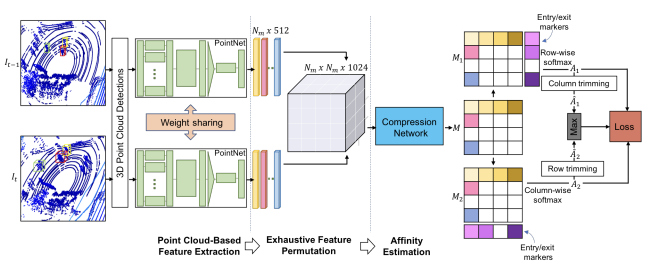
PC-DAN for 3D Multiple Object Tracking: Introduced a novel deep learning model for 3D Multi-Object Tracking that processes sparse LiDAR data with a unique feature permutation approach achieving top leaderboard performance at a Stanford University CVPR workshop. (Funded by Lockheed Martin)
Satellite Image Segmentation: Improved remote sensing image segmentation by modifying U-Net and PSPNet models effectively classifying roads, buildings, grass, and water with enhanced accuracy.
Real-Time Visual Saliency Detection: Proposed a CNN based model for saliency detection in SAR images reducing computational complexity and enabling real-time remote sensing applications. (Funded by Shanghai Jiaotong University, China)
- Programming Languages: Python, MATLAB, C++, JAVA
- Frameworks & Libraries: PyTorch, TensorFlow, OpenCV, Open3D
- Tools & Platforms: Linux, Git, Docker, CARLA
- Systems Knowledge: Robot Operating System, Sensor Fusion Tech., ML Models
- Granted Graduate Presentation Fellowship by UCF College of Graduate Studies (2022)
- Won Stanford’s JackRabbot Challenge 3D Tracking Competition (CVPR 2021)
- Awarded with ORC-Fellowship from University of Central Florida for First Year of PhD (2021)
- Awarded with fully funded 2 years Chinese Govt. Scholarship by CSC China (2018)
- Awarded with fully funded 4 years National ICT Scholarship (2011)
- Awarded Recognition of Institution Merit Scholarship Certificate for securing 3.81 GPA in 7th semester of bachelor’s degree (2014)
- Secured 3rd position in Pakistan in IEEEXtreme-2014 programming competition and first in Sukkur IBA University Pakistan. (2014)